
FAXVIN reports consist of several sections and contain a plethora of information about vehicles sold after 1982.
Our reports are designed to provide our customers with comprehensive vehicle specifications and a complete vehicle accident history, salvage and total loss event history, pulled from reports from insurance companies throughout all 50 US states. Additionally, we also offer Title History information that enables individuals to learn the title brand, dates the vehicle may have been purchased and registered, along with any liens that may have been put on the vehicle title.
Our comprehensive Vehicle History reports may include maintenance and service records, extending to any time the vehicle may have been towed, to recalls and services performed on the vehicle.
Customers can use FAXVIN to screen countless vehicles. The goal of our service is to enable you to make informed purchasing decisions when buying a vehicle. Never make the costly mistake of paying for someone else’s problem. Running a full vehicle history report gives you the insight you need to make the right decision.
FAXVIN CarRank is a tool included in the FAXVIN automobile history report that gives you a quick snapshot of the past of the vehicle and be able to compare it to others. It is an essential tool since it minimizes the risks of purchasing a car with unnoticed issues.
The history of your automobile significantly determines the FAXVIN CarRank.
Here are factors that can impact on Vehicle’s FAXVIN CarRank negatively:
- Rollback mileage.
- Accidents involved.
- Title brands, for instance, rebuilt or salvaged titles.
- Past users of the vehicle.
- Water and frame damages.
- Inspection and service history.
- Thefts and retrieval records.
- Defects and recalls.
- Issues with the odometer, e.g., defective or rollback odometer.
- Registration and inspection.
- And much more...
In a nutshell, think of FAXVIN CarRank as a summary of the extensive list of a vehicle history. With the FAXVIN CarRank for different vehicles, you can quickly compare them and make the right decision. For instance, he FAXVIN CarRank for Nissan Pathfinder is 54 points, and for the Ford F-150 is 89 points. With this quick information, you will be able to know that you should opt for Ford.
The FAXVIN CarRank range from 1 to 100. However, it is advisable to read these points in comparison with the ratings assigned to the other vehicles.
The history of VIN numbers dates back to the 1950’s when Detroit automobile manufacturers started identifying vehicles with specific stamps and casts. The goal of this newfound vehicle identification number (VIN) was to provide a precise description of the vehicle post mass production. As more vehicles were made, it became obvious a new system of identification was needed.
The first VINs were made in countless variations and based on the manufacturer. It wasn’t until the first half of the 1980’s that the U.S. National Highway Traffic Safety Administration (USDOT) started requiring road vehicles have a 17 character VIN. The Vehicle Identification Number was set in the ISO Standard 3779 in 1977 and later was revised in 1983. Originally it was designed to identify motor vehicles, motorcycles, mopeds, and trailers. This set a standard for the future VIN System, which is used by manufacturers to this day.
Today, every vehicle has it’s own “DNA” of sorts, from the moment they drop off the assembly line.
VIN’s can be found in a few different locations, depending on your vehicle. For most vehicles, you can find the VIN on your front driver’s side dashboard underneath the windshield. You’ll have to find it from the outside of your vehicle. Alternatively, you may find it on the driver’s side door post or under the hood inside the engine bay.
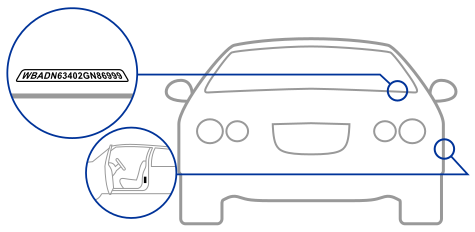
If you have trouble locating your VIN on your vehicle, you may also check out the following places:
- Insurance Card
- Vehicle Title
- Vehicle Registration